How to Choose the Best Paper (and Material) for Large Format Printing
Paper selection for large format printing isn't just about aesthetics — the wrong substrate can fail outdoors, wrinkle indoors, or simply look wrong for the application. Here's how to choose correctly.
Material Selection Is the Most Important Large Format Decision
In large format printing, the substrate you choose affects not just how your piece looks but how long it lasts, how it's installed, how it ships, and whether it survives its environment. A material perfectly suited for a trade show display will fail completely as an outdoor banner. A fabric backdrop that looks stunning in a photography studio would be impractical for a construction site fence wrap.
The Decision Framework: Five Key Questions
- Indoor or outdoor? Outdoor applications need UV-resistant inks and weatherproof substrates.
- Temporary or permanent? Days vs. weeks vs. months vs. years.
- Rigid or flexible? Signs on walls or stands may benefit from rigidity; hanging banners need flexibility.
- How is it installed? Hung from grommets, mounted with standoffs, applied as adhesive, displayed in a frame?
- Viewed at what distance? This affects resolution requirements and how surface texture affects perceived quality.
Flexible Substrates
Vinyl Banner (Scrim Vinyl)
The workhorse of large format printing. Scrim vinyl consists of a woven polyester mesh laminated between layers of PVC, available in weights from 7 oz to 18 oz per square yard.
- Best for: Outdoor banners, event signage, trade shows, construction banners
- Durability: 1–3 years outdoor, depending on exposure and weight
- Typical finishing: Hemmed edges with grommets, pole pockets
Mesh Vinyl
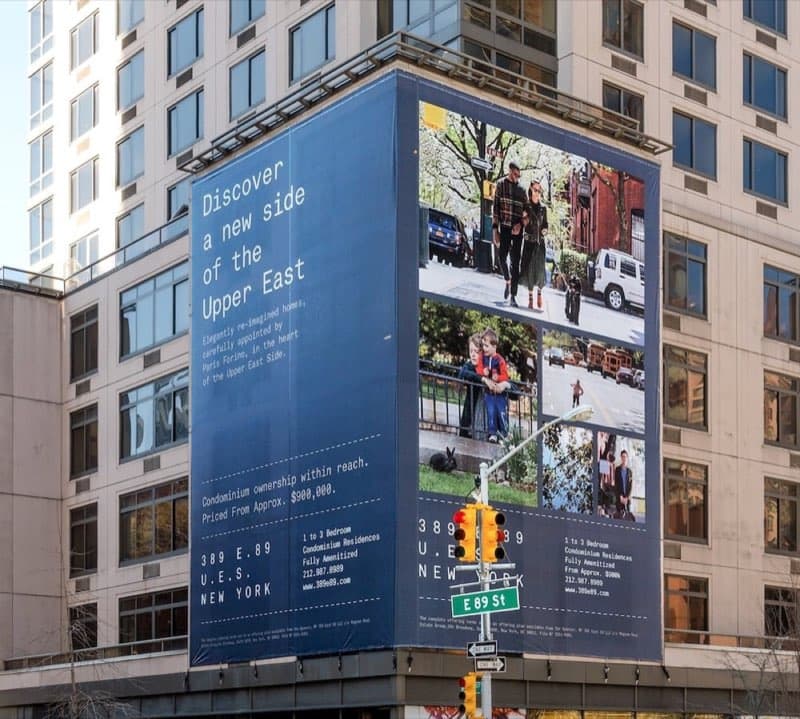
Perforated vinyl that allows air to pass through — critical for large outdoor banners on building facades where wind load is a concern. Note that the perforations reduce visible print area by 30–50%, so colors appear less saturated than on solid vinyl.
Fabric (Dye-Sublimation)
Dye-sublimation printing transfers dye directly into polyester fabric using heat, producing vibrant, seamless color. The fabric is lightweight, wrinkle-resistant, and machine-washable.
- Best for: Trade show backdrops, retail environments, event drapes, tension fabric display systems
- Not for: Outdoor use (fabric absorbs moisture, dye-sub colors fade in UV)
Adhesive Vinyl
Vinyl with a pressure-sensitive adhesive backing. Available in permanent (vehicle wraps, long-term wall graphics), removable (temporary displays, short-term window advertising), static cling (fully repositionable, no adhesive), and window perf / one-way vision (opaque from outside, visible from inside) formulations.
Rigid Substrates
Foam Board and Gatorboard
Foam board (polystyrene foam sandwiched between smooth faces) and gatorboard (denser, harder version) are lightweight and economical. Best for indoor presentations and temporary retail signage — not for outdoor use, as foam board warps in humidity.
Sintra (PVC Foam Board)
Expanded PVC sheet — lightweight, rigid, slightly flexible, and moisture-resistant. Can be used semi-outdoors in covered locations. Best for indoor retail signage and trade show booth elements.
Coroplast (Corrugated Plastic)
Twin-wall polypropylene corrugated sheet — lightweight, weather-resistant, and economical. Best for outdoor yard signs and temporary outdoor signage lasting weeks to months.
Dibond (Aluminum Composite)
Two sheets of aluminum bonded to a polyethylene core. Rigid, flat, lightweight, and weather-resistant. Best for premium indoor and outdoor signage, wayfinding, and long-term applications. Durability: 5–10+ years outdoors with UV-resistant inks.
Acrylic
Clear or colored acrylic sheet with excellent optical clarity. Printed on the back (reverse printing) for a glass-like display effect. Best for luxury retail displays, corporate signage, and fine art reproduction.
Making the Call
When in doubt, describe your application to your printer and let them recommend a substrate. A good large format printer will ask about your installation location, duration, viewing environment, and budget before making a recommendation.
VSL Print stocks a full range of large format substrates and can advise on selection for any application. Bring us the brief and let us help you choose the material that will make your project look its best and hold up to its environment. Smaller-sheet projects follow a different menu, which our concise guide to offset printing materials catalogs stock by stock.
Matching Material to Common Applications
To translate the framework into practice, here's how the material decision tends to resolve for everyday large-format projects:
- Outdoor banner for an event or storefront: Scrim vinyl with hemmed edges and grommets; mesh vinyl if it will hang on a building facade exposed to wind.
- Trade show backdrop: Dye-sublimated tension fabric — lightweight, wrinkle-resistant, packs small, and photographs beautifully under booth lighting.
- Indoor directional or retail sign: Foam board or Sintra for short-term, Dibond for a durable, premium look.
- Yard or sidewalk sign: Coroplast — cheap, weatherproof for weeks to months, and easy to stake.
- Window promotion: Removable adhesive vinyl, or perforated one-way vision film if interior visibility must be preserved.
- Luxury reception or gallery display: Reverse-printed acrylic for a glass-like depth, or canvas for fine-art reproduction.
Lamination and Protective Finishes
Material choice doesn't end with the substrate — surface protection often determines how long a piece looks good. A gloss laminate boosts color saturation and resists moisture; a matte laminate cuts glare for graphics under bright or angled light; anti-scratch and anti-graffiti laminates protect high-touch installations like floor graphics and elevator wraps. Floor graphics in particular require a textured, slip-resistant overlaminate rated for foot traffic, not a standard film. Specifying the right finish is as important as the substrate itself: an unprotected print in a demanding environment can scuff or fade long before the material underneath would have failed.
Frequently Asked Questions
What's the most versatile all-purpose large-format material? Scrim vinyl for flexible banners and Dibond for rigid signs cover the majority of common needs between them.
Can fabric displays go outdoors? Generally no. Fabric absorbs moisture and dye-sublimation color fades under UV. Use vinyl or rigid weatherproof substrates outdoors.
How long will an outdoor banner last? A typical scrim vinyl banner lasts one to three years outdoors depending on weight, ink system, and sun exposure. Dibond with UV inks can last five to ten years or more.
Weight, Shipping, and Handling Considerations
Material choice has logistical consequences that are easy to overlook until the piece arrives. Rigid substrates like Dibond and acrylic are heavy and must ship flat, often by freight for larger sizes, and they require careful packaging to avoid corner damage. Foam board is light but dents easily and warps in humidity, so it's a poor choice for anything that ships far or installs in a damp environment. Flexible materials ship compactly — vinyl banners roll into tubes, and fabric folds into a small box — which makes them friendlier for events that travel. Factoring weight, packing, and transport into the material decision avoids the unpleasant surprise of a beautiful sign that's impractical or expensive to get to its destination intact. Many clients sidestep the freight question entirely by using NYC printing services close to the install site, where pickup or messenger delivery replaces a loading dock wait.
Indoor Light and Surface Finish
For interior pieces, the lighting environment should steer the surface finish. Under bright spotlights or near windows, a glossy laminate can produce distracting glare and hot spots that wash out the graphic; a matte or satin finish diffuses light and keeps the image readable from more angles. In dim or evenly lit spaces, gloss can add welcome saturation and depth. Backlit applications — light boxes and illuminated displays — need a specific translucent film engineered so color reads correctly when lit from behind rather than reflected from the front. Matching the finish to how and where the piece is lit is as important as choosing the substrate beneath it.
Frequently Asked Questions (More)
Which material is best for a reusable trade show backdrop? Tension fabric — it's lightweight, packs small, resists wrinkles, and sets up quickly show after show.
What should I use for a short-term outdoor sign? Coroplast for staked yard signs, or scrim vinyl for hung banners. Both are weather-resistant and economical for weeks-to-months use.
Looking for professional specialty printing?
View Specialty PrintingReady to start your print project?
Get a free quote from a NYC commercial printer. Rush turnaround available.