Large Format vs. Digital Printing: Key Differences Explained
Both large format and digital printing use inkjet or toner technology — so what makes them different? The answer involves output size, substrate type, viewing distance, and the right application for each.
Two Types of Digital Printing — But Very Different Applications
Here's a point of confusion that trips up many print buyers: large format printing is technically a form of digital printing. Both use digital files, both eliminate printing plates, and both commonly use inkjet technology. So what makes large format printing a distinct category? The differences are substantial and practically important.
The Core Distinction: Scale and Substrate
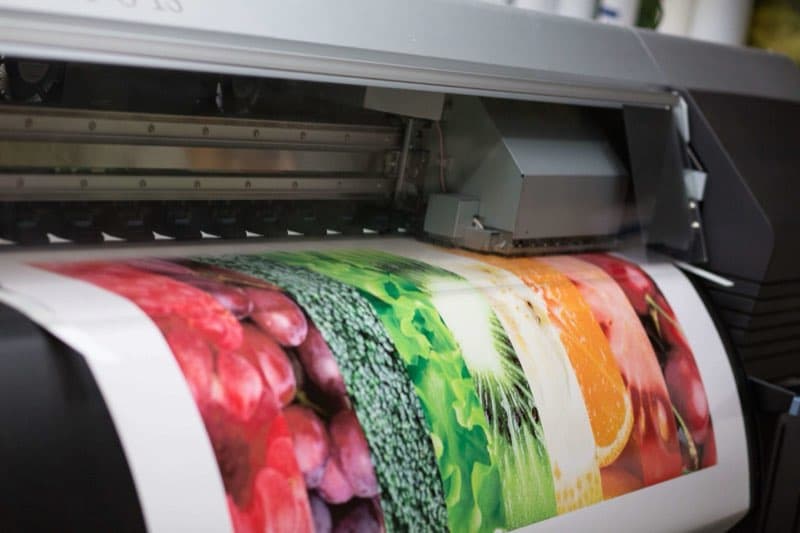
Standard commercial digital printing — used for brochures, business cards, booklets, and stationery — operates on press sheets typically no larger than 13" × 19" for sheetfed digital presses. Large format printing operates on roll-fed wide-format inkjet presses with print widths ranging from 24" up to very wide production formats. The entire product category is defined by its ability to produce oversized output that standard presses physically cannot accommodate.
Key Differences: Standard Digital vs. Large Format
Maximum Output Size
- Standard digital printing: Typically maxes out at 13" × 19" (SRA3) for most production digital presses. A few high-capacity digital presses handle up to 26" × 40".
- Large format printing: Starts where standard digital ends. Practical output sizes range from 24" wide up to very wide production formats on the largest roll-fed printers, with no practical length limit on roll-fed systems.
Substrate Range
- Standard digital printing: Primarily paper-based — cut sheets of coated and uncoated paper, light board stocks. Substrate range is limited by the paper path and fuser system.
- Large format printing: An enormous range including rigid boards (foam board, Dibond, PVC, acrylic), flexible materials (vinyl, mesh, fabric, polyester), and specialty media (canvas, backlit film, floor graphics material, vehicle wrap vinyl).
Resolution and Viewing Distance
- Standard digital printing: Outputs at 600–1200+ dpi, designed for materials viewed at reading distance (12"–24").
- Large format printing: Typically outputs at 72–200 dpi at full size, calibrated to the expected viewing distance. A banner viewed from 20 feet doesn't need 1200 dpi.
Ink Systems
- Standard digital printing: Primarily toner (electrophotographic) or sheet-compatible aqueous inkjet inks formulated for paper.
- Large format printing: Solvent (highly durable, outdoor-grade), UV-curable (instant cure, works on rigid substrates), latex (water-based but durable, low VOC), and dye-sublimation (for fabric). Each ink system has specific applications, durability profiles, and substrate compatibilities.
Finishing and Installation
- Standard digital printing: Finished by cutting, folding, binding, and laminating.
- Large format printing: Finished by hemming, grommeting, pole pockets, mounting, contour cutting, and often installation on walls, hung from ceilings, wrapped around vehicles, or applied to glass surfaces.
When to Use Standard Digital Printing
- Brochures, flyers, postcards, business cards, booklets
- Variable data printing (personalized mailers, QR-coded pieces)
- Short-run books and catalogs
- Any piece printed on standard paper stock and read at close range
When to Use Large Format Printing
- Banners (indoor and outdoor)
- Trade show displays and backdrops
- Retail window graphics and wall murals
- Event signage and stage backdrops
- Vehicle wraps and fleet graphics
- Construction site fence wraps and building wraps
- Floor graphics and posters (24" × 36" and larger)
- Architectural and wayfinding signage
Some Projects Need Both
Corporate events, retail openings, and trade shows routinely require both standard digital printing (brochures, programs, business cards, name badges) and large format printing (backdrops, signage, banners) for the same project. At VSL Print, we handle both in-house — which means a single contact, a single project timeline, and consistent brand colors across all print formats. Scheduling both streams gets easier once you know realistic large format turnaround times, which our quick guide maps product by product.
Why Brand Color Consistency Across Formats Is Hard
One subtle challenge when a single campaign spans both standard digital and large format is keeping brand colors consistent across very different machines, inks, and substrates. A logo blue printed with toner on a coated business card, with latex ink on a fabric backdrop, and with UV ink on a rigid sign passes through three distinct color systems. Without coordinated color management, those three blues can drift apart noticeably. A printer that runs all the formats in-house and manages color to a common standard can hold them close — which is a practical, not just convenient, reason to consolidate a multi-format project with one shop rather than splitting it across vendors.
Cost Structure: Per-Piece vs. Per-Square-Foot
The two categories are even priced on different logic. Standard digital printing is typically quoted per piece or per impression, with quantity as the main driver and a sharp economy of scale on setup. Large format is priced primarily by square footage, where doubling both dimensions roughly quadruples material and ink cost, and where quantity matters less because there are few plates or setups to amortize. This is why ordering a thousand brochures is dramatically cheaper per unit than ordering ten, while ordering a second identical banner saves far less per unit than the first. Understanding which pricing logic applies helps you budget each part of a mixed project realistically.
Durability and Environment: A Different Set of Demands
Standard digital pieces live indoors, are handled at reading distance, and rarely face weather. Large format pieces frequently must survive sun, rain, wind, and months of outdoor exposure — or withstand the handling and reuse of trade show life. That difference drives the entire materials-and-ink conversation: UV-resistant inks, weatherproof substrates, laminates for scuff protection, and wind-permeable mesh for large outdoor banners. Choosing large format isn't only about going bigger; it's about engineering a piece to survive an environment that standard print products never encounter. Permanent exterior work such as building signage takes that engineering further, pairing weatherproof materials with professional installation.
Frequently Asked Questions
Is large format just "big digital printing"? Technically it's a form of digital printing, but the substrate range, ink systems, resolution-by-distance approach, and finishing make it a distinct discipline with different rules.
Can one printer handle both for my event? Yes — and it's usually preferable. A single in-house shop gives you one timeline, one point of contact, and coordinated brand color across cards, programs, banners, and backdrops.
Why is a small banner sometimes pricier per piece than a stack of brochures? Different pricing logic. Large format is square-footage based with little setup to spread out, while brochures benefit from steep per-unit economy of scale at higher quantities.
File Preparation Differs Too
The distinction extends all the way back to how files are built. Standard digital and offset work is prepared at 300 dpi at final size in CMYK, with tight bleed around a small trim. Large format flips several of those assumptions: resolution is set by viewing distance and is often far lower than 300 dpi, files are commonly built at a fraction of final scale and enlarged, bleed allowances are larger, and vector elements matter even more because artwork may be scaled dramatically. A designer fluent in standard print prep can still trip over large format by over-building files or under-specifying scale. Knowing which set of rules applies before you start prevents both wasted effort on impossibly large files and disappointment from soft, upscaled output.
Picking the Right Category for the Job
The clearest way to decide is to ask two questions: How big is the finished piece, and how is it viewed? If it fits on a standard press sheet and is read at arm's length — cards, brochures, booklets, mailers — standard digital or offset is the home. If it's oversized, mounted, hung, wrapped, or installed in a physical environment — banners, displays, murals, vehicle graphics — it belongs in large format. Many real projects answer "both," and the practical advantage of a shop that runs both is a single coordinated timeline and consistent brand color from the smallest business card to the largest backdrop.
Looking for professional large format printing?
View Large Format PrintingReady to start your print project?
Get a free quote from a NYC commercial printer. Rush turnaround available.