Digital Printing Pricing: The Ultimate Guide to What You'll Pay and Why
Digital printing pricing feels opaque until you understand what drives it. We break down every cost factor — quantity, size, paper, turnaround — so you can budget accurately and compare quotes fairly.
Why Digital Printing Quotes Vary So Much
You send the same file to three printers and get back quotes that differ by 40%. Sound familiar? Digital printing pricing has many variables, and understanding each one puts you in control of your budget — and helps you evaluate whether a low quote represents genuine value or a corner being cut somewhere.
This guide walks through every significant cost driver in digital printing, so you can budget accurately, compare quotes fairly, and make smart decisions for every project.
The Core Pricing Variables
1. Quantity
Quantity has a bigger effect on digital printing pricing than most buyers expect. Unlike offset printing — where large setup costs create a steep volume discount curve — digital printing has lower fixed costs (no plates) but higher variable costs per impression. The result: digital pricing doesn't scale as dramatically with quantity as offset.
That said, quantity still matters significantly:
- At very low quantities (1–25 pieces), per-unit costs are highest because setup, handling, and minimum run charges are spread over few pieces.
- From 50–500 pieces, digital printing hits its sweet spot — economical enough to be practical, without the waste of overprinting.
- At 500–2,000+ pieces, offset printing often becomes competitive, and printers may recommend switching processes entirely.
2. Print Size and Format
Larger sheets consume more substrate and more ink, so they cost more. But the relationship isn't purely linear — press sheet sizes impose natural breakpoints. A piece that fits 8-up on a press sheet may cost only marginally more than a piece that fits 10-up; a piece that requires a larger sheet size jumps in cost.
Standard sizes (letter, tabloid, A4, A3) are typically the most economical because they're optimized for common press sheet dimensions with minimal waste. Custom sizes often incur die-cutting charges and higher substrate waste.
3. Paper and Substrate
Paper is frequently the second-largest cost in a digital print job after the press time itself. Key factors:
- Weight: Heavier stocks cost more per sheet but may reduce or eliminate the need for separate cover stock.
- Coating: Coated stocks (gloss, silk, matte) generally cost more than uncoated but produce more vibrant color and are more compatible with most digital presses.
- Specialty substrates: Synthetic papers (waterproof, tear-resistant), textured stocks, and heavy boards command premium prices and may require specific press configurations.
- House stock vs. special order: Printers maintain inventory of commonly used papers; special-order stock adds cost and may extend lead time.
4. Color Coverage and Ink Density
Digital presses — especially toner-based systems — cost more to run with high ink coverage. A page that's 80% covered in dense solid colors uses significantly more toner than a lightly designed page. Some printers price on a per-impression basis regardless; others use coverage-based pricing that accounts for this variable. If your design features heavy solid backgrounds or full-bleed photography on every page, be aware that this may affect your quote.
5. Single-Sided vs. Duplex
Printing both sides of a sheet (duplex) costs more than single-sided, but typically less than double the single-sided price — because the paper and handling costs are shared. For products like brochures, flyers, and booklets where two-sided printing is standard, the premium is modest.
6. Finishing Operations
The press cost is often only a portion of the total job cost. Finishing adds up quickly:
- Cutting: Simple trim cuts are inexpensive; complex die-cutting is significantly more.
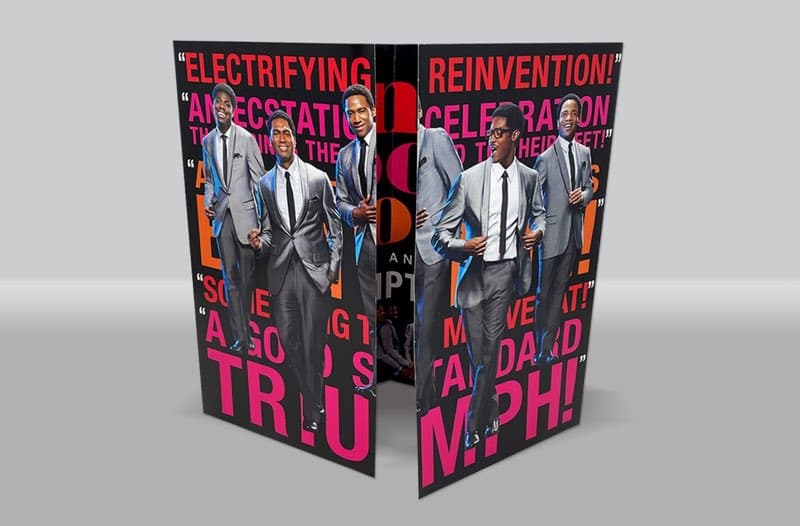
- Folding: Parallel folds are straightforward; multi-panel folds (8-panel accordion, gatefolds) cost more due to setup and handling.
- Lamination/coating: Gloss or matte lamination adds durability and premium feel but at meaningful cost per square foot.
- Binding: Saddle-stitching (stapled) is economical; perfect binding and case binding are progressively more expensive.
- Hole drilling, scoring, perforating: Each additional operation adds time and cost.
7. Turnaround Time
Rush premiums are real. Standard turnaround (3–5 business days) is priced at base rates. Same-day or next-day jobs often carry a 25–50% rush surcharge, reflecting the overtime, press priority shuffling, and expedited shipping involved. If your project isn't genuinely urgent, planning ahead is one of the easiest ways to reduce printing costs.
8. Variable Data Printing (VDP)
If your job includes personalized content — unique names, addresses, QR codes, or images that change per piece — variable data processing adds cost. VDP requires data preparation, database management, and in some cases slower press speeds. The complexity of the variable elements (simple text swaps vs. complex image personalization) drives the cost. Most VDP quotes we prepare are for direct mail printing and mailing, where list processing and postage join the print costs.
Understanding Digital Printing Price Structures
Printers structure their digital printing pricing in a few common ways:
- Per-piece pricing: A flat cost per printed unit, often tiered by quantity. Clean and simple, but may obscure whether finishing is included.
- Per-impression pricing: Cost per side printed, separate from paper and finishing. Common in commercial print environments.
- Package pricing: Fixed prices for standard products (e.g., "500 4×6 postcards on 16pt stock"). Easy to compare but may not include customization.
- Custom quoting: For complex jobs, printers calculate press time, paper, finishing, and overhead individually. More accurate but requires more lead time.
Hidden Costs to Watch For
When comparing quotes, watch for costs that may not be itemized explicitly:
- File preparation / prepress fees: Correcting a file that doesn't meet specs can add unexpected charges.
- Proof charges: Hard-copy proofs (physical printed proofs) often cost extra; soft proofs (PDF) are typically free.
- Shipping and delivery: Local NYC delivery and freight to out-of-town addresses are often quoted separately.
- Tax: Printing tax rules vary by jurisdiction and product type.
- Minimum order charges: Many printers have minimums that apply if your order falls below a threshold value.
How to Get an Accurate Quote
To get a precise, comparable quote from any printer:
- Specify exact finished dimensions (width × height after all folds and cuts)
- State quantity clearly
- Describe the substrate: weight, coating, color
- List all finishing operations
- State your required delivery date and location
- Clarify whether you're supplying print-ready files or need design work
At VSL Print, we provide itemized quotes so you can see exactly where every dollar goes. Transparent pricing isn't just good customer service — it's how we help clients make informed decisions rather than unpleasant discoveries when the invoice arrives. Bindery charges are the ones most worth understanding, and our guide to digital print finishing options shows what each operation adds.
When Digital Costs More Than Offset — and Vice Versa
The most consequential cost decision often isn't a line item at all — it's choosing the right process in the first place. Digital printing wins decisively at low quantities because there are no plates and minimal setup. But because digital has a higher cost per impression, that advantage erodes as quantity climbs. Somewhere around 500–1,500 pieces (the exact crossover depends on size, coverage, and stock), offset's low marginal cost overtakes digital's low setup cost. Past that point, ordering digitally can cost substantially more for an identical product. A printer who runs both processes can model the crossover for your specific job rather than defaulting to whatever press is free.
Five Practical Ways to Lower Your Print Bill
- Order to a standard size. A finished size that ganged efficiently on the press sheet wastes less paper than an odd custom size.
- Choose a house stock. Papers the printer already inventories cost less and avoid special-order lead time.
- Avoid unnecessary rush. Building one or two extra days into your schedule sidesteps rush surcharges entirely.
- Bundle related pieces. Running several items together shares setup and handling.
- Send clean, print-ready files. File-correction fees and proofing rounds add cost you can avoid up front.
Frequently Asked Questions
Why did two printers quote such different prices for the same job? Differences usually come down to which process they assumed, the stock they spec'd, whether finishing and proofing were included, and minimum order charges. Compare itemized quotes, not just bottom-line numbers.
Is a hard-copy proof worth paying for? For color-critical or high-value jobs, yes — a calibrated proof is cheap insurance against an expensive reprint. For routine repeat jobs, a free PDF soft proof is usually enough.
Do heavier paper and full-bleed coverage really raise the price? Yes. Heavier stock costs more per sheet, and on toner presses heavy ink coverage consumes more toner — both can move a quote noticeably.
Looking for professional digital printing services?
View Digital Printing ServicesReady to start your print project?
Get a free quote from a NYC commercial printer. Rush turnaround available.